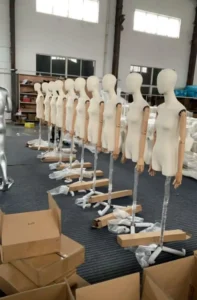
Every year, brand managers come to us with the same panic: “We need mannequins in 3 weeks.” And every year, we have to be the ones who say no. Because the truth is, a single custom mannequin takes 10 to 14 weeks from the first design conversation to the moment it lands at your distribution center.
In this article, I’m going to show you exactly what happens in each of those weeks—what the factory is doing, what decisions need to be made, and where most timelines fall apart. This is the same breakdown I walk my clients through on day one of every project.
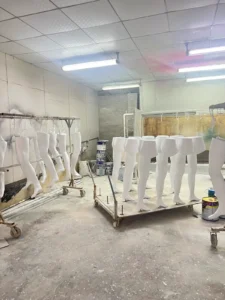
Mannequin Production Timeline at a Glance
| Phase | Duration | Key Activities |
|---|---|---|
| Design and Sampling | Weeks 1-4 | Concept confirmation, 2D drawings, first prototype |
| Mold and Tooling | Weeks 5-8 | Mold creation, trial shots, modifications |
| Bulk Production | Weeks 9-11 | Mass production, inline QC checks |
| Final QC and Packaging | Week 12 | 100% inspection, export packaging, palletizing |
| Shipping and Customs | Weeks 12-14 | Sea freight, customs clearance, last-mile delivery |
Total: 10-14 weeks for standard orders. Complex orders with unusual materials or highly customized finishes can run 16-20 weeks.
Week 1-2: Design Concept and Technical Confirmation
The project officially starts when we have three things confirmed: a signed purchase order with payment terms, approved 2D reference sketches, and written sign-off on our pre-production drawing (PPD).
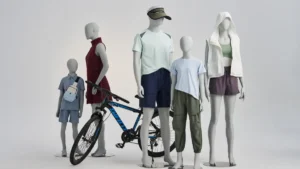
During these two weeks, we review body pose, material specification (fiberglass, ABS, or bio-based resin), finish color (Pantone reference), and surface treatment requirements. For sportswear mannequins, we confirm shoulder width, torso length, and hip-to-waist ratio against the brand size chart.
Week 3-4: First Sample (Prototype) Production
This is where your concept becomes a physical object. The sample room produces the first-generation prototype in the agreed material, with hand finishing and surface preparation.
Most timeline delays happen at this stage. Projects are routinely delayed 2-3 weeks because clients request posture or proportion adjustments after seeing the first sample. The single most important advice I can give: approve the sample in writing before mass production begins.

Week 5-8: Mold Creation and Tooling
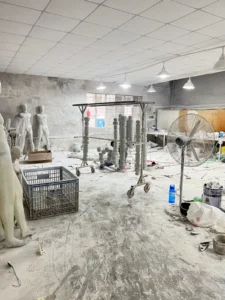
A proper mold for a full-body mannequin costs $800 to $3,000 USD and takes 3-5 weeks to produce. The mold is the difference between 50 identical mannequins and 50 slightly different ones.
Using an existing mold instead of creating a new one can save you 3-5 weeks and $1,000-$3,000 per mold. This is one of the most underutilized time-saving strategies in the mannequin industry.
Week 9-11: Bulk Production with Quality Control
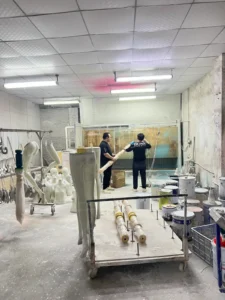
With approved molds, bulk production begins. During this phase, we run at minimum 3 inline quality checks:
- During-mold QC: Surface finish and structural integrity immediately after demolding
- Pre-paint QC: Dimensions and surface preparation before any coating is applied
- Final QC before packaging: 100% visual inspection of every single unit
For international orders, we also conduct third-party inspection (TPI). Brands like H&M and Decathlon require TPI reports as a condition of final payment. We work with QIMA and Bureau Veritas.
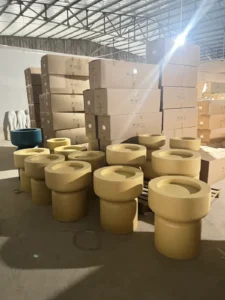
Week 12: Final QC, Packaging, and Documentation
Week 12 is where we make everything ship-ready:
- 100% inspection of all units (visual + dimensional)
- Individual polybag wrapping and foam corner protection
- Export-grade double-wall cartons (K=Kraft, minimum 5-ply)
- Carton labeling: PO number, size, color, quantity, country of origin
- Palletizing and container loading
- Document preparation: commercial invoice, packing list, Bill of Lading, Certificate of Origin
Weeks 13-14: Shipping, Customs, and Last-Mile Delivery
Production is done. Now the clock shifts to logistics.
| Route | Sea Freight Time |
|---|---|
| Ningbo/Shanghai to Los Angeles | 14-18 days |
| Ningbo/Shanghai to Rotterdam | 28-32 days |
| Ningbo/Shanghai to Felixstowe (UK) | 30-35 days |
| Ningbo/Shanghai to Sydney | 20-25 days |
Add 3-5 days for customs clearance and 2-5 days for last-mile delivery to your warehouse.
The 6 Most Common Timeline Disasters
1. Revisions After Sample Approval
Every revision after sample approval adds 1-3 weeks to the timeline. Resolve all concerns before you sign off on the sample. This is non-negotiable.
2. Color Matching Fails
Pantone references are guides, not guarantees, especially across different materials. Always request a physical color chip from the actual production material before bulk production starts.
3. Peak Season Delays
September through November is peak season for mannequin factories. Orders placed in July may wait 2-3 weeks just for a production slot. Book your slot 4-6 months in advance.
4. Material Shortages
Bio-based resins and specific fiberglass grades can have 3-4 week lead times from suppliers. Confirm material availability before the project starts.
5. Documentation Errors
Missing or incorrect documentation is the #1 cause of customs delays for mannequin shipments. Assign a dedicated freight forwarder who specializes in retail fixtures.
6. Payment Delays
Most factories will not release goods without payment clearance. International wire transfers take 3-5 business days. Build this into your project plan.
How to Plan Your Mannequin Project: The 6-Month Rule
- 6 months before needed: Initial inquiry and factory qualification
- 5 months before: Design concept and sample approval
- 4 months before: Bulk production begins
- 2 months before: Goods ship from China
- 6-8 weeks before needed: Goods arrive at your warehouse
Bottom line: start looking for a factory 6 months before you need the goods. This is the single most important planning rule in mannequin procurement.
Frequently Asked Questions
How long does custom mannequin production actually take?
Custom mannequins typically take 10-14 weeks from design approval to departure from the factory. This includes sample production (3-4 weeks), mold creation (3-5 weeks), and bulk production with quality checks (4-6 weeks). Sea freight adds another 2-6 weeks depending on destination.
Can mannequin production be expedited?
Yes, but at a significant cost. Expedited production (4-6 week total) typically carries a 30-50% surcharge on the production cost. Using existing molds and standard materials can reduce lead time by 3-5 weeks compared to fully custom work.
What causes the most delays in mannequin production?
Post-approval revisions are the #1 cause of delays, adding 1-3 weeks per revision cycle. Peak season allocation waits (2-3 weeks) are the second most common issue. Proper pre-production planning and decisive sample approval can prevent most delays.
When should I start planning a mannequin order for a new store opening?
For custom mannequins, begin your factory search 6 months before the planned in-store date. For orders using existing molds, 3-4 months is sufficient. Always build in a 2-week buffer at each milestone. Production schedules rarely run perfectly to plan.
Conclusion: Give Your Project the Time It Needs
Mannequin production cannot be rushed without consequences. Every shortcut we take at the sample stage, every mold trial we skip, every QC checkpoint we reduce shows up as a defect in the final product that arrives at your store.
At Richen Mannequin, we build quality checkpoints into every phase precisely because we know that catching a problem at the sample stage costs $200. Catching it after 500 units have been produced costs $15,000.
Give your project the time it needs. Start by choosing the right factory partner – one who will tell you the truth about timelines, not just say yes to get your order.
Internal Links & Resources
Browse Related Products: View our mannequin collection on Alibaba — production examples and current pricing
Store Fixture Solutions: For custom store fixtures and display solutions for your retail brand, visit Morshopfitting’s blog — store fixture guides and industry insights
Learn More About Our Factory: About Richelannequin — 19 years manufacturing mannequins in Tongxiang, China