Mike Yang
Founder & R&D Director, Morshopfitting / Richen Mannequin | 19 Years in Mannequin & Store Display Manufacturing | MAMMUT, lululemon Supplier
Ten years ago, most sportswear brand managers I met at trade shows had the same response when I told them where our factory was: “We get our store displays from Europe.” It was a reasonable position. Back then, the quality gap between Chinese and European manufacturing was real, and the risk of outsourcing something as visible as your store display to an unknown factory felt too high.
Today, that conversation has completely flipped. Almost every major sportswear brand I work with—directly or through their visual merchandising agencies—has some component of their store display production in China. And yet, the way most brands approach that sourcing is fundamentally broken.
This isn’t a pitch. I’m not going to tell you that China is right for every brand. It’s not. But I am going to tell you what’s actually changed, what most brands get wrong about sourcing from China, and what the brands doing it well do differently.
What Actually Changed in the Last Decade
The quality argument against Chinese manufacturing peaked around 2015–2018, and it’s weakened every year since. Here’s what actually moved:
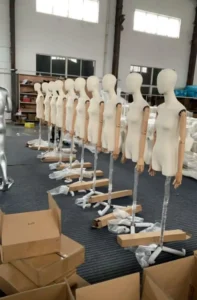
Tooling investment is global now. The KUKA robotic arms in our factory are the same models used in German automotive component manufacturing. Our CNC equipment comes from the same suppliers. The gap in equipment access has essentially closed for any factory willing to invest—and the factories that survive long-term in this business are the ones that did invest.
The talent moved. When I started in 2007, the best finishers in fiberglass work were in Italy and Spain. Today, some of the finest finishers I’ve worked with are Chinese technicians who trained with European factories, then came back—or stayed. The skill transfer that happened in the 2010s was enormous.
Supply chains are now specialized. When you work with a generalist factory, you get generalist results. The factories that have survived and grown are the ones that specialized—becoming genuinely excellent at mannequin and display production, rather than trying to make everything. Specialization creates depth. Depth creates quality.
What Most Sportswear Brands Get Wrong
In my experience working with brand managers from Europe, North America, and Australia, the same mistakes appear over and over:
Mistake #1: Treating China as One Option, Not a Supply Chain
Brands often approach Chinese sourcing as a binary decision: find a factory, get a quote, place an order. That’s not how it works in practice—and the factories that encourage that approach are usually the ones you want to avoid.
The real value of Chinese manufacturing for sportswear brands is in building a supply chain relationship—one that compounds over years. A factory that understands your brand standards, your seasonal timelines, your packaging requirements, and your QC language takes enormous friction out of every subsequent project. The first order is always the hardest. The fifth is where the value appears.
Mistake #2: Choosing on Price, Not on Process
A price that’s 40% below market isn’t a deal. It’s a signal that the factory is cutting something—and you won’t find out what until the shipment arrives.
The brands I’ve seen get burned consistently chose a supplier based on unit price, not on the quality of their production process. Here’s a direct quote from a brand VM manager who came to us after a bad experience: “The price was incredible. We thought we were being smart. We spent more in re-orders, internal labor, and missed windows than we saved ten times over.”
The math on store display economics is simple: a 200-piece order at premium quality might cost 30% more upfront. If the alternative delivers a 5% damage rate instead of 0.3%, you’re replacing 10 pieces. At $80–120 per piece for air freight re-orders, you’ve already spent the premium. And that’s before you count the internal team hours managing the problem.
Mistake #3: Skipping the Sample Phase
No matter how pressed you are for time before a store opening or a trade show, skipping样品 is almost always more expensive in the long run. The sample phase exists for a reason: it surfaces problems when they can be fixed cheaply, not when they’ve already been multiplied across 200 pieces.
Mistake #4: Not Knowing What Their Factory Actually Makes
I’ve toured factories that claim to specialize in mannequins and found them making industrial equipment, car parts, and decorative sculptures alongside mannequin orders. When your order is 20% of a factory’s capacity, you’re always competing for attention.
Ask specifically: What percentage of your production is mannequins and store displays? If the answer isn’t clear, that’s your signal to look elsewhere.
What the Brands Doing It Well Do Differently
I’ve worked with sportswear brands ranging from independent specialty retailers to international chains with hundreds of stores. The ones who get the most value from their Chinese supply relationships share some specific behaviors:
They build the relationship before they need it. The brands that come to us with urgent requests during peak season are the ones who end up paying the most and accepting compromises. The brands that engage us 6–8 months before their store rollout have time on their side—and they use it.
They visit—physically or virtually. Every serious brand we work with has done a video call inside our factory before placing a first order. Not a Zoom presentation with slides. An actual walk through the production floor. The factories that are proud of their work will show it to you. The ones that won’t show you their floor are hiding something.
They define quality before they define specs. Quality means different things to different brands. For a premium sportswear retailer, it might mean exact color matching to a Pantone chip and zero visible seam lines. For a value retailer, it might mean durability at a price point. The factories that deliver best are the ones who understand your quality definition—not just your technical specifications.
What China Actually Costs vs. Europe: The Real Numbers
I won’t give you a number here because every project is different. But I will tell you what the brands who do this seriously tell me: the total installed cost of a Chinese-manufactured store display—factory cost, quality inspection, export packaging, freight, and duties—is typically 40–60% less than the equivalent European product. For a 50-store rollout, that difference is usually six figures.
That number doesn’t mean automatically choose China. It means the budget conversation should be had with full cost visibility, not just unit price comparison.
When China Is Not the Right Answer
I want to be honest about this, because the brands that come to us after a bad experience with a cheaper supplier have usually been told exactly what they wanted to hear. I’m going to tell you the cases where Chinese manufacturing is probably not your best option:
- Fewer than 10 pieces per design. The setup cost of a dedicated mannequin production run doesn’t economics at very low volumes. Distributors or European small-batch manufacturers may serve you better here.
- Ultra-luxury fashion with bespoke finishing. If your brand is positioning at the very highest end and your customers will notice hand-finishing quality at millimeter level, European factories with established luxury heritage may be worth the premium.
- Same-season rush production. Even with air freight, Chinese production takes 10–14 weeks minimum for a quality result. If you need something in four weeks, the answer is your existing supplier, not China.
- Products requiring EU or US local compliance certification that is impractical to obtain. Some compliance requirements make Chinese production impractical for certain applications. Always check before specifying.
The Question You Should Be Asking
Most brand managers ask: “Can this factory make what I need?”
The better question is: “Is this factory set up to consistently make what I need, at the quality I need it, on the timeline I need it, for as long as I need it?”
The first question has a yes-or-no answer. The second one takes a conversation—and usually a factory visit or a video call—to answer honestly.
If you’re evaluating Chinese store display manufacturers for your sportswear brand, I’m happy to have that conversation with you directly. No obligation. No sales pitch. Just a honest read on whether we’re the right fit for what you’re trying to do.
Get in Touch with Mike Directly
Mike Yang has been in mannequin and store fixture manufacturing since 2007, with production experience across sportswear, outdoor, and fashion retail brands. He responds to genuine project inquiries directly.
Contact Mike Yang — Morshopfitting / Richen Mannequin
LinkedIn: Mike Yang — Shopfitting & Fixtures | Factory Tour Video (YouTube)
WhatsApp / Phone: +86 137 5771 7214 | Email: wzruichen@gmail.com
Morshopfitting / Richen Mannequin | Tongxiang City, Zhejiang Province, China | MAMMUT, lululemon, DUVETICA, HOKA Supplier
Mike Yang is the Founder of Morshopfitting / Richen Mannequin, a mannequin and store display fixture manufacturer based in Tongxiang, Zhejiang Province, China. This article reflects operational experience from 19 years of store display production for international sportswear and fashion brands.
Disclosure: Morshopfitting / Richen Mannequin is a manufacturer. We earn revenue when brands choose to place orders with us after reading this article. We’ve written it to be genuinely useful, not persuasive — our goal is to help you make a better-informed decision, regardless of who you end up working with.