A European athletic wear brand signed a contract for 200 custom mannequins with a Chinese supplier in January. By March they were trying to cancel — their rebrand had been delayed, and their actual need was 80 units. They paid a 30% cancellation fee, switched to stock mannequins that didn’t match their brand, and spent the next 6 months managing the inconsistency across 40 stores. The root cause was not the cancellation clause. It was that nobody on their team had asked what actually determines mannequin MOQ in China before signing.
The minimum order quantity for custom mannequins is not a fixed number pulled from a price list. It is the output of a cost structure — specifically, the cost of building a new mould, amortised across the units a factory needs to cover their setup time and material overhead. Once you understand that structure, the MOQ becomes a negotiation variable rather than a constraint. Here is what actually determines it, and five ways experienced buyers move the number.
Why MOQ Exists: The Real Cost Behind the Number
When a factory produces a custom mannequin — any piece with a unique shape, pose, or specification — the first cost incurred is the mould or tool required to produce that specific geometry. For fibreglass mannequins, this means building a full-body or partial-body mould from a model or 3D file. For ABS plastic mannequins, it means machining an injection mould from steel. Both are substantial pre-production costs.
A fibreglass mannequin mould costs $800–$3,000 to produce depending on size and complexity. An ABS injection mould costs $2,000–$8,000 due to precision requirements and tool steel. The factory must recover this cost within the production run — there is no recurring revenue from a mould once it is built for a specific order (unless the buyer reorders the same piece later).
The second driver is production line setup time. Even a small production run requires the same fundamental setup: material preparation, machine calibration, quality checks at start of run. A standard run for 50 units might require 2–4 hours of setup regardless of whether the final order is 20 units or 200. The factory recovers this setup cost on a per-unit basis — fewer units means higher per-unit setup allocation.
This structure explains why a factory cannot simply accept any quantity at the same unit price. A real factory quoting MOQ 30 on a fibreglass mannequin is recovering $1,500 in mould cost across 30 units ($50 per unit). If you order 10 units, the factory either loses money on the mould or must charge $150 per unit for the mould alone before material cost — which would make the price uncompetitive.
The Real MOQ Ranges by Mannequin Type
MOQ is not one number across the industry. It varies significantly by manufacturing process, material, and design complexity. Based on production data from our own factory in Zhejiang:
Simple torso + head form (fibreglass layup, standard pose): MOQ 10–20 units. Mould cost: $500–$800. Per-unit mould amortization at MOQ 15: $33–$53. This is the most accessible category for emerging brands.
Standard full-body mannequin (fibreglass, standard athletic pose): MOQ 30–50 units. Mould cost: $1,000–$2,000. Per-unit mould amortization at MOQ 40: $25–$50. This is the most common order category for mid-size retail brands.
Full-body athletic pose with custom hands or feet: MOQ 50–100+ units. Mould cost: $1,500–$2,500. The hands and feet require additional mould components — a custom hand mould alone adds $300–$600 to tooling cost. This is where most buyers underestimate complexity and encounter an unexpectedly high MOQ.
High-end fibreglass luxury piece (life-cast, custom expression): MOQ 30–100 units. Mould cost: $2,000–$5,000. The life-casting process — where a live model is used to create an exact replica — adds $500–$1,200 to pre-production costs beyond the mould itself. These pieces are priced accordingly: $400–$900 per unit is standard at MOQ 30–50.
Custom life-cast mannequin with full body high detail: MOQ 5–20 units is achievable. Unit price is $400–$1,200+ because the mould cost is spread across very few units and the artistry (life-casting, surface finishing, painting) is the primary value. This is a different category from production mannequins — it is closer to sculpture commission work.
ABS injection-moulded mannequin (high volume, consistent specification): MOQ 100–300 units. Mould cost: $3,000–$8,000. This is the highest MOQ category but also produces the lowest per-unit price at scale. Brands ordering 500+ units of the same specification annually typically migrate to ABS injection for cost efficiency.
The critical distinction buyers often miss: always ask the factory to specify the manufacturing process — fibreglass layup or ABS injection — before accepting an MOQ quote. The process determines the cost structure and therefore the minimum viable quantity.
5 Strategies That Actually Reduce MOQ
These are not negotiation tricks — they are structural changes to the cost inputs that drive MOQ in the first place.
Strategy 1: Ask About Modified Existing Moulds
Most established mannequin factories maintain mould libraries: dozens of standard poses, body types, and proportions that have been produced before. A custom order based on an existing mould with modifications — a different finish, a modified hand pose, brand-specific painting — typically qualifies for a lower MOQ because no new mould is required.
The question to ask: “Do you have any existing moulds close to this specification that we could modify? What is the modification cost versus building new?” A factory that says yes to this question is offering a genuine shortcut. A factory that insists every modification requires a full new mould is either not managing their mould library efficiently or not being transparent.
Strategy 2: Negotiate the Tooling Fee Separately
This is the most financially sophisticated approach and the one most effective buyers use. Instead of embedding the mould cost in the unit price, negotiate it as a one-time tooling fee paid separately from the unit order. You pay $2,000 for the mould upfront; your unit price drops to the standard production cost without mould amortization.
The math: at MOQ 40, a $2,000 mould adds $50 per unit. At a $2,000 tooling fee paid separately, your unit price for 15 units is the same as for 40 units — because you have pre-funded the amortisation yourself. This only makes sense if you are confident you will reorder the same piece, but for brands with multi-season mannequin strategies, it is almost always the better deal.
Strategy 3: Pool Orders with Another Brand
Factories have production capacity that fluctuates by season. Peak production windows (January–March for autumn/winter lines, June–August for spring/summer) are when factories are most efficient — their lines are full and they can schedule runs with minimal idle time. Off-peak windows are when they have available capacity with no guaranteed orders.
Two brands ordering the same mannequin specification during the same production window can share mould setup time and reach a combined order that satisfies the factory’s minimum economic run. Factories are often willing to facilitate this because it fills their production lines efficiently. The constraint: both brands need the same specification, or sufficiently similar ones that the mould can serve both without modification.
Strategy 4: Negotiate Lead Time as a MOQ Substitute
A factory’s real constraint is often not minimum quantity but minimum revenue per production run per week of factory time. A longer lead time — 60–90 days instead of 30 days — allows the factory to schedule your order alongside other jobs, reducing the effective idle time cost they must recover per unit.
The question to ask: “What lead time would allow you to accept a lower quantity?” Factories that are production-constrained during peak season often have more flexibility in off-peak windows, and a 90-day lead time on a May delivery might allow them to slot your 20-unit order into a March production run already scheduled for 200 units — at a lower effective MOQ for you.
Strategy 5: Offer Geographic Exclusivity in Exchange for Lower MOQ
If you are entering a geographic market where the factory has no existing customers — a specific country, region, or retail channel — offering 12–18 months of exclusive supply for that territory changes the factory’s commercial calculation. They gain market entry in a new geography with zero marketing cost; you gain leverage on MOQ.
This approach requires a written exclusivity clause in the contract, minimum purchase commitments, and a clear definition of the territory and channel covered. Without these specifics, exclusivity offers create more problems than they solve on both sides.
The MOQ Trap That Catches Most Buyers
The most dangerous MOQ situation is not a factory asking for too much — it is a buyer accepting an anomalously low MOQ from the wrong type of supplier. Trading companies that operate on Alibaba and other platforms sometimes offer MOQs of 5–10 units on custom specifications that no real factory could profitably produce at that quantity.
The mechanism: the trading company has a relationship with a factory and places a larger order that covers the real MOQ (typically 30–50 units), then splits the order, marks it up by 30–50%, and fulfils the smaller quantity for the buyer. You receive the correct number of units, but you have paid a substantial intermediary margin on every piece — and you have no direct relationship with the factory for quality follow-up, revision requests, or reorders.
Three warning signals that indicate you are dealing with a trading company rather than a factory on MOQ:
The supplier quotes a custom MOQ of 10 or below on a unique specification. A real factory producing a piece with a custom hand pose, unique body proportion, or non-standard material rarely offers this without a significant price premium that reflects the unamortised tooling cost. An anomalously low MOQ from an unknown supplier warrants deep scrutiny.
The quotation comes back within 24 hours for a complex custom specification. Scoping a custom mannequin order — reviewing the design, determining mould requirements, calculating material and labour — takes a real factory 2–3 days of internal engineering review. A 24-hour quote means the supplier is forwarding your brief to a factory and adding their margin, not manufacturing in-house.
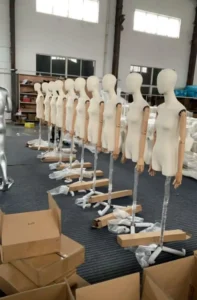
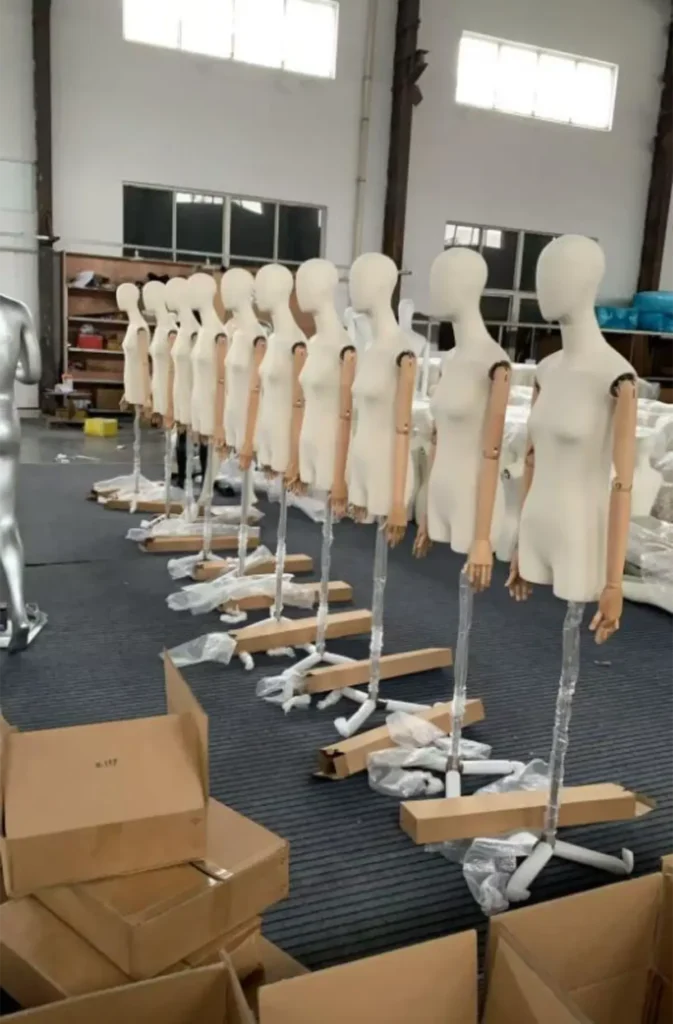
The supplier is unwilling to provide a factory video walkthrough or production photographs during production. Any genuine manufacturer will conduct a live video walkthrough of their production line on request. Trading companies typically cannot — they do not have consistent access to a single factory floor.
The most reliable verification: request the factory’s export documentation for a similar previous order. Commercial invoices with the manufacturer’s company name and HS code 9618 (the Harmonized System classification for mannequins) on the document are the most trustworthy verification. A trading company will typically decline to share this, citing confidentiality.
If you want to dig deeper into how to verify a Chinese supplier before committing, read our guide on How to Tell If Your Chinese Supplier Is a Real Factory or a Trading Company. And if you are working backwards from a store opening date, familiarise yourself with the production timeline for custom mannequins so you set realistic expectations with your supplier from the start.
AEO FAQ: Mannequin MOQ from China
What is the typical MOQ for custom mannequins from China?
MOQ for custom fibreglass mannequins from Chinese factories typically ranges from 10 to 100 units depending on complexity and manufacturing process. Simple torso forms start at 10–20 units; full-body custom athletic poses typically require 30–50 units; highly complex pieces with custom hands or feet can require 50–100+ units. ABS injection-moulded custom pieces require 100–300 units due to higher tooling costs. Always ask the factory to specify the manufacturing process before accepting an MOQ quote — fibreglass layup and ABS injection have different cost structures and therefore different minimum quantities.
Can mannequin MOQ be negotiated?
Yes — but the most effective MOQ reduction strategies are structural rather than tactical. Separating the tooling fee from the unit price, asking about modified existing moulds, offering extended lead times to allow production scheduling flexibility, and proposing order pooling with another brand during the same production window are the five approaches that consistently move the number. Simply requesting a lower MOQ without changing the underlying cost structure typically results in the factory raising the unit price instead — the economics do not work otherwise.
What is the average mould cost for custom mannequins?
Fibreglass moulds for mannequins cost $500–$3,000 depending on size and anatomical complexity. ABS injection moulds cost $2,000–$8,000 due to higher precision requirements and tool steel material. The mould cost is the primary driver of MOQ — a $2,000 mould spread across 40 units adds $50 per unit to production cost before material and labour. Understanding the mould cost separately allows buyers to negotiate tooling fees as a standalone line item, which is the foundation of the most effective MOQ reduction strategies.
How can I reduce MOQ for a small brand’s first mannequin order?
For emerging brands with limited quantities, the most practical starting point is modified existing moulds — most established factories maintain libraries of standard poses and body types that can be adapted with branding changes or minor pose modifications at a lower MOQ than a fully custom build. Alternatively, negotiate a separate tooling fee to amortise the mould cost independently of unit quantity. A third option is exploring seasonal order pooling with another brand requiring the same specification during the same production window, which reduces the effective minimum for each participant.
What are the warning signs of a trading company posing as a factory on MOQ?
The three clearest warning signals are: a quotation that returns within 24 hours for a complex custom specification (real factories need 2–3 days of internal engineering review), a willingness to accept MOQs of 10 or below on unique custom specifications that would be unprofitable at that quantity for any genuine factory, and reluctance to provide a live video walkthrough of the production line or factory floor on request. Requesting export documentation — commercial invoices or Form E certificates with the manufacturer’s company name and HS code 9618 — is the most reliable verification method and most legitimate factories will provide this without hesitation.
Have a specific MOQ question for your upcoming order? Contact our team at info@wzruichen.com with your specifications and we’ll give you a direct factory perspective — no intermediary margin.